

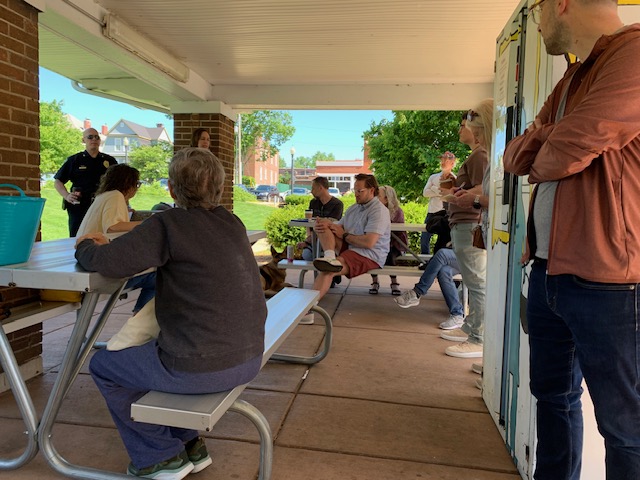
About 40 Maplewood residents, city council members, staffers and others gathered at the Sutton Loop Park shelter for two hours on Saturday to discuss whatever was on their minds—mainly it was the failed proposition to raise funds to improve the city hall building, and what will happen now since it failed in the April election, and the unhoused people that spend time at the Sutton Loop Park shelter.
A proposition similar to Prop M will be before voters in the November elections. Mayor Barry Greenberg said Prop M failed by 50 votes [it was required to pass with 57% yes votes, it received about 53%]. He said the city will have more community meetings, more city hall tours, and more opportunities for feedback. He implied that better education about the need will convince residents to vote yes.
When a resident said that if the proposition cost was reduced it might have a better chance of passing, City Manager Amber Withycombe said the cost presented in April was the base cost, and that the ‘no vote’ received doesn’t remove the need for the improvements.
Ward 1 council member Wiley C added that the failed proposition contained the bare minimum, and that the HVAC system is in danger of failing. Also, Police Chief Matt Nighbor said the department’s CALEA certification could depend on improvements for the department, and that Maplewood’s police facilities are in the top five worst in all of St. Louis County.
Then, under the Sutton Loop Park shelter, a resident asked about the group of unhoused people that gather there on many days. Several residents had concerns about safety and sanitation. Ward 3 council member Nick Homa said there’s no solution yet, and that everyone’s needs have to be met.
Social Services Coordinator Celeste Grayer said there are currently 15 unhoused living in Maplewood, and two of them are using the city’s services. She said she checks on them everyday, that they can’t be forced into treatment, and that the individuals have free will to gather at the shelter. If someone is jailed, when they are released—usually within a week, the cycle continues until the individual improves.
Chief Nighbor said everyone has rights, and the offenses committed are usually minor, resulting in minimum jail time or four-five hours in a hospital. He also emphasized that if anyone sees public defecation, urination, or especially drug use to call the police.
A few residents suggested that if the food pantry was removed from the shelter that would solve the problem, but others said the food doesn’t bring them; they gather for the shared community.
Some residents who live nearby, on Maple Avenue, said they have lived with the situation for years. They have gotten to know some of them, and said conversations with the unhoused may have been uncomfortable, but they haven’t felt unsafe. It was also noted that many of them have roots in Maplewood.
Greenberg said Maplewood is a compassionate community, but a plan of action is wanted. He said the city council is there to listen, whether it’s about moving the pantry, or even building more shelters to accommodate everyone.
Concerned citizen May 25, 2026 At 8:40 am
Take the tour behind the scene at City Hall and see the need before you make a semi-informed decision. Do you buy clothes, shoes, a car, or a house sight unseen? Do not vote blindly…….ask for a tour if you are not available for those that are offered. There are sides to every story….
Could we share what we witnessed
Take the tour behind the scene at City Hall and see the need before you make an semi-informed decision. Do you buy clothes, shoes, car, or a house sight unseen? Do not vote blindly…….ask for a tour if you are not available for those that are offered. There are sides to every story….
I attended a meeting concerning the State of Homeless in the St Louis Area today, May 21, 2026 at Peter and Paul Homeless Services Organization. At this meeting, it was stated that the need for affordable housing is asking for Communities, Business Owners and any empty housing to help the current condition our Metro Area is experiencing. I know of empty spaces in the Special Business District; second-floor units are being wasted. Many of the displaced people are elderly. Maplewood has seen a lot of prosperity; it would be showing decent humanity to help with this need.
I know there is empty space on the second floor of the Old Maplewood City Hall on Sutton. And other buildings. A human consideration would be to make them habitual for some of the citizens of Maplewood, MO, without housing. I have followed the disaster Cara Spencer is trying to manage with her administration, and it is not pretty. There are two kinds of humans (the Decent and the Indecent).
No one is doubting that the police department could use some upgrading. Not sure about the city hall offices. The question seems to be about making home owners pay for it by increased property taxes. Since half of Maplewood’s population consists of renters, it seems the burden would fall the home owners. Surely, there are alternative funding resources in a successful community like ours. No?
Yes-so sick of this-the people spoke and said NO-we are getting taxed to death during inflation, skyrocketing gas prices, outrageous home prices and now THIS?!
Nope: Exactly. Is this another Respect Missouri Voters issue…except in Maplewood? Come on now, we said No and it’s not about the community NOT wanting upgrades for City Hall and Police. It’s about ridiculously bad timing to be asking homeowners to up their property taxes for this. They are already high enough currently. How do they know things will be better in November? They don’t. Take this off the ballot. The people spoke.
Yes, from what I’ve heard they have a rainy day fund. At least use that. Renters might eventually be affected, but not right away as they sign contracts for pricing. Also, renters can be much more transient and move to another district without having a house they have to repair, upgrade and try to sell.